If you’re planning server upgrades, workstation refreshes, or any major hardware purchases in 2026, there’s something you need to know: we’re heading into one of the most significant hardware price surges in recent memory.
This isn’t speculation—it’s already happening. And while the underlying causes are complex, the impact on your IT budget and timelines is straightforward: costs are rising, availability is tightening, and waiting could mean paying more for equipment that takes longer to arrive.
Here’s what’s happening, why it matters, and what you can do about it.
The Numbers: How Much Are Prices Rising?
Let’s start with the facts. According to industry analysts and supply chain reporting:
Memory (DRAM) prices are climbing sharply:
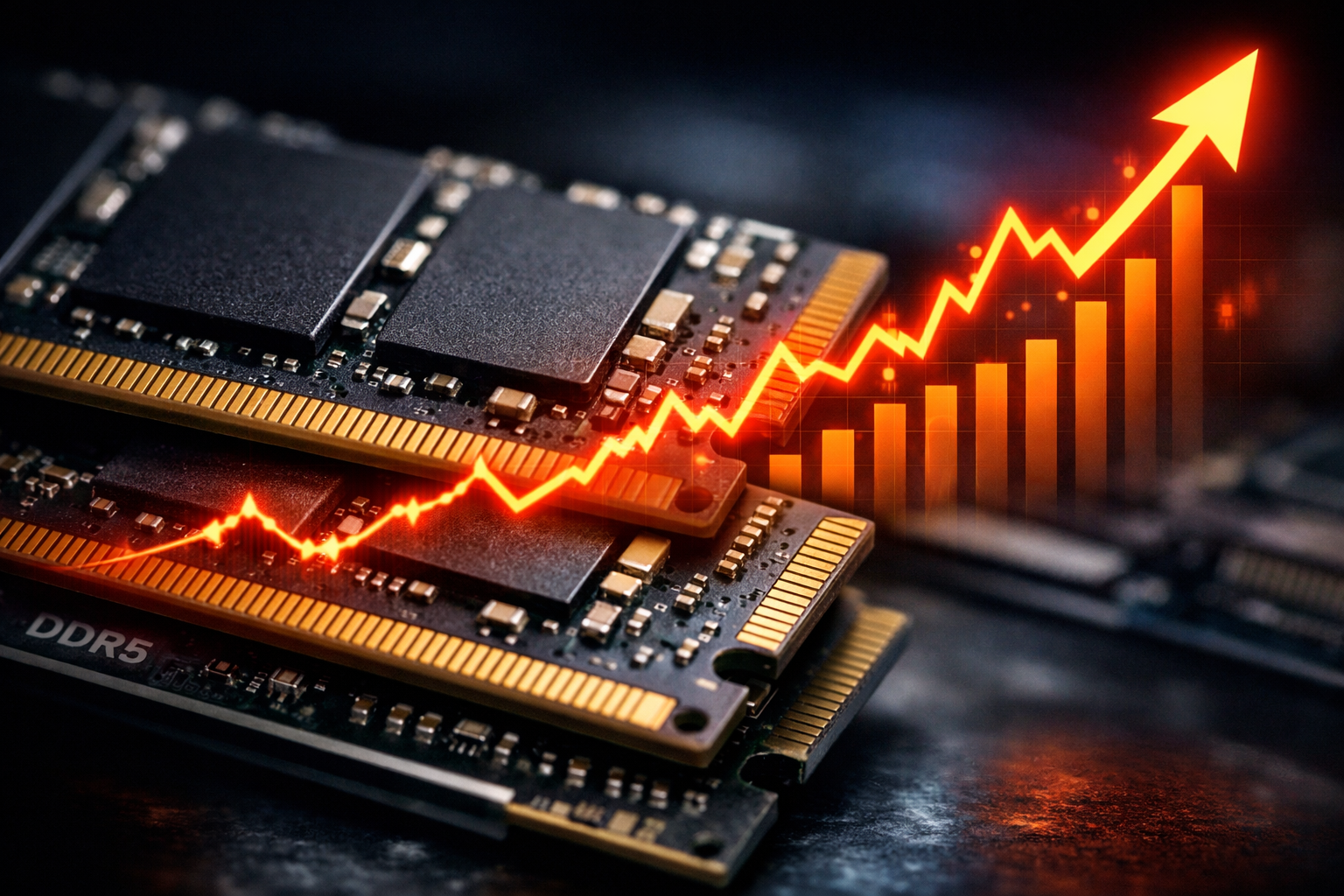
- Conventional DRAM (including DDR5) contract prices are projected to rise 55–60% quarter-over-quarter in Q1 2026
- Server DRAM is seeing even steeper increases—over 60% in some categories
- This isn’t a small correction; it’s one of the most dramatic price swings we’ve seen in years
Storage (NAND/SSD) isn’t far behind:
- NAND flash contract prices are expected to jump 33–38% in the same period
- SSDs across all capacities and form factors are affected
OEMs are passing costs along:
- Dell, Lenovo, HP, and HPE are preparing price increases of approximately 15% on servers
- PC pricing is also rising, though more modestly at around 5%
- These aren’t list price adjustments—they’re affecting channel pricing and street costs
The result? A server configuration that cost $8,000 last quarter could easily run $9,200+ by Q2. Multiply that across a fleet refresh, and the budget impact becomes significant.
Why Is This Happening?
The root cause is straightforward: AI infrastructure is consuming memory supply at an unprecedented rate.
Artificial intelligence and machine learning workloads—particularly large language models, generative AI, and deep learning—require massive amounts of high-speed memory. Companies building AI datacenters aren’t just buying a few servers; they’re deploying thousands of systems with maxed-out DRAM configurations and specialized high-bandwidth memory (HBM).
Memory manufacturers have responded by reallocating production capacity:
- Shifting DDR5 and NAND production toward server and AI-optimized modules
- Prioritizing HBM (high-bandwidth memory) manufacturing for AI accelerators
- Reducing output of mainstream consumer and enterprise memory products
The problem? There’s only so much manufacturing capacity to go around. When AI datacenter orders absorb the lion’s share of DRAM and NAND production, less is available for everything else—including the PCs, workstations, and general-purpose servers that most businesses rely on.
And unlike previous shortages driven by natural disasters or temporary supply disruptions, this one is structural. AI demand isn’t slowing down. Analysts warn that tight supply conditions could persist for months—possibly years.
What This Means for Your Hardware Plans
If you’re planning IT infrastructure investments in 2026, here’s what you’re likely to encounter:
1. Higher System Costs—Especially for Memory-Intensive Configurations
Servers and professional workstations with high RAM requirements will see the biggest price jumps. If your refresh involves:
- Database servers (64GB, 128GB, or higher memory configurations)
- Virtualization hosts (maxed-out RDIMM configurations)
- Engineering or creative workstations (high-capacity DDR5)
…expect costs to climb significantly. Even “standard” 32GB configurations may cost more than you budgeted.
2. Longer Lead Times
It’s not just about price. Availability is becoming a real issue.
Certain memory capacities and speeds—particularly 64GB and 128GB RDIMMs, and faster DDR5 speeds like 5600MT/s and 6400MT/s—are seeing extended lead times. What used to ship in 2–3 weeks might now take 6–8 weeks or longer, depending on supplier allocation.
If your project has a hard deadline (end-of-fiscal-year refresh, office move, compliance requirement), delayed hardware delivery can create serious operational risk.
3. Fewer Configuration Options
As suppliers focus production on high-priority SKUs, lower-volume configurations are being deprioritized or discontinued. You may find that your preferred memory speed, capacity, or brand simply isn’t available—forcing last-minute configuration changes or substitutions.
This also applies to storage. Certain SSD capacities (particularly enterprise NVMe drives in specific densities) are becoming harder to source.
What You Can Do About It
The good news? With the right approach, you can mitigate most of these risks. Here’s what we’re recommending to clients:
1. Pull Forward Your Orders
If you have hardware refreshes or new projects planned for Q1 or Q2 2026, consider accelerating your timeline. Ordering now—or at least locking in quotes and reserving inventory—can help you:
- Secure current pricing before the next wave of increases
- Avoid extended lead times as supply tightens further
- Get ahead of potential allocation constraints
Even if you don’t need the equipment immediately, taking delivery early may be worth it to lock in lower costs.
2. Right-Size Your Memory Specs
Not every workload needs maxed-out RAM. Before you spec a server with 256GB because “it’s nice to have headroom,” take the time to:
- Validate actual memory utilization on current systems
- Tune workloads to run efficiently within realistic memory limits
- Consider whether you can achieve performance goals with faster CPUs, GPUs, or NVMe storage instead of just throwing more RAM at the problem
In a tight market, efficiency isn’t just good practice—it’s a cost-saving strategy.
3. Explore Strategic Procurement Options
Standard one-off purchasing may not be the best approach right now. Depending on your needs, consider:
- Multi-quarter commitments: Lock in pricing and allocation for future quarters
- Leasing or financing: Spread costs and reduce upfront capital impact
- Blanket purchase orders: Reserve capacity with your vendor to ensure availability
- Buffer stock for critical SKUs: Keep a small inventory of hard-to-source components (e.g., specific RDIMM modules) to avoid project delays
4. Plan for Configuration Flexibility
Don’t lock yourself into a single “ideal” spec. Work with your IT partner to identify acceptable alternatives:
- Approved memory speeds (e.g., DDR5-4800 vs. 5600 if supply is tight)
- Alternative densities (e.g., 4x32GB instead of 2x64GB)
- Vendor substitutions (Samsung vs. Micron, etc.)
Having pre-approved alternatives reduces risk and keeps projects on track even if your first-choice components aren’t available.
The Bigger Picture: This Isn’t a Short-Term Blip
It’s worth understanding that this isn’t a temporary supply hiccup. AI infrastructure investment is reshaping the entire memory market, and the effects will ripple through the industry for years.
Memory manufacturers are already announcing multi-billion-dollar investments in new fabrication capacity—but new fabs take 2–3 years to come online. In the meantime, supply will remain constrained, and prices will remain elevated.
For IT leaders, this means adjusting to a new normal:
- Hardware procurement requires more planning and lead time
- Budget flexibility is critical (costs may shift between quote and purchase)
- Vendor relationships matter more than ever (allocation often favors committed customers)
How We’re Helping Clients Navigate This
At i-Tech, we’re actively working with clients to stay ahead of these challenges:
- Proactive roadmap reviews: We’re reaching out to clients with upcoming projects to discuss timing, budgets, and configuration strategies
- Real-time market intelligence: We monitor pricing trends, lead times, and supplier allocation so you don’t have to
- Vendor relationships: Our partnerships with Dell, Lenovo, HP, and others give us visibility into allocation and priority access where possible
- Alternative solutions: When a specific configuration isn’t feasible, we help identify cost-effective alternatives that still meet your performance and budget goals
If you have hardware plans for 2026—whether it’s a major refresh, expansion project, or even a few critical replacements—now is the time to start the conversation.
Next Steps
Planning a hardware refresh or upgrade in 2026?
Reach out to your Client Success Manager or reply to this post. We’ll:
- Review your roadmap and identify projects at risk
- Validate configurations and recommend cost-effective alternatives
- Provide updated quotes that reflect current market conditions
- Help you lock in pricing and availability before things get tighter
The worst thing you can do right now is wait and hope prices come down. They won’t—at least not in 2026.
Further Reading
Want to dig deeper? Here are the sources behind this analysis:
- TrendForce Q1 2026 Outlook: Memory Makers Prioritize Server Applications — Detailed breakdown of price increases and allocation dynamics
- PCWorld (January 12, 2026): DRAM and SSD Shortages Could Last Months to Years — Vendor interviews from CES 2026
- Tom’s Hardware (December 5, 2025): Dell and Lenovo Preparing Major Price Hikes Amid DRAM Crunch — Early reporting on OEM pricing strategy
Have questions about your 2026 hardware plans? Contact us today—we’re here to help you navigate this market and make smart decisions for your business.