ERP Solutions to Elevate Retail and eCommerce Operations
Enhance customer experiences, optimize inventory, and streamline order fulfillment with Acumatica ERP tailored for retail and eCommerce businesses.
Connect Every Channel Without Creating More Operational Drag
Running a retail or distribution business across multiple channels means managing many moving parts. Online storefronts, warehouse inventory, order fulfillment, and financials. When those systems don’t connect, the gaps show up fast: duplicate data entry, inventory counts that are already wrong by the time someone checks them, and order status questions nobody can answer without digging through three different platforms.
Acumatica Retail Edition is designed for growing retail businesses typically doing $15 million plus in revenue and connects your storefronts, back office, inventory, purchasing, financials, and warehouse operations on a single cloud-based platform. Your inventory, orders, customer data, and financials stay in sync across every channel, whether you’re selling on Shopify, through Amazon, on BigCommerce, in a showroom, or all of the above.
We’ve helped retailers and distributors implement and configure Acumatica Retail Edition since 2015. We know where the complexity lives and how to set it up so it works the way your business does.
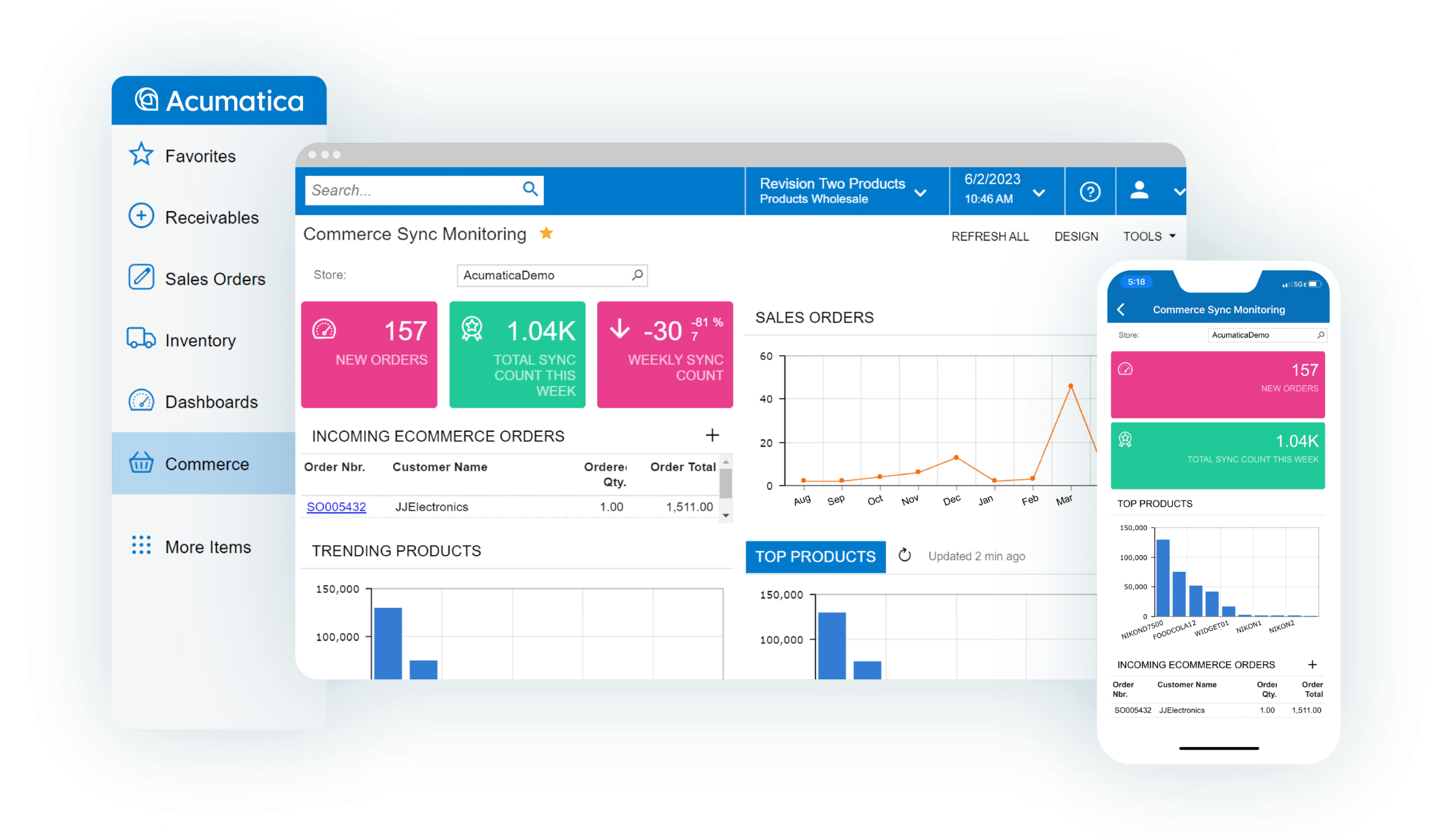
One ERP Platform for Retail, Ecommerce, Inventory, and Financials
- Connect Shopify, Amazon, and BigCommerce to your back office with native connectors, no middleware, no manual uploads
- Keep inventory counts accurate across every sales channel and warehouse location in real time
- Automate the order-to-cash cycle from online purchase through fulfillment and invoicing
- Manage B2C and B2B sales from one platform, including customer-specific pricing, matrix items, and multi-warehouse fulfillment
- Get per-unit profitability data, not just overall margin, so you know which products and channels are performing
- Access financial reporting, dashboards, and order status from any device, anywhere
- Work with a Gold Certified Acumatica partner with a 100% implementation success rate and a 4.68 average NPS

Which eCommerce Platforms Does Acumatica Connect To?
Acumatica Retail Edition includes native connectors for the platforms that mid-market retailers and distributors use most. These are built directly into Acumatica and maintained as part of the platform, not bolted on through third-party middleware. Here’s what each one does.
Shopify + Acumatica
Acumatica’s native Shopify connector runs entirely within Acumatica. It syncs bidirectionally in real time, so changes in either system are reflected in both without manual intervention and supports international markets.
What it keeps in sync:
- Products, pricing, descriptions, images, and inventory levels are updated across both platforms as changes happen
- Sales orders and fulfillment data flowing from Shopify into Acumatica’s order management module
- Customer records between both systems
- Shopify POS transactions are imported directly into Acumatica, so in-store and online sales are consolidated in one place
- Fraud risk data from Shopify flagged on incoming orders
The connector also supports Shopify Plus for enterprise retailers, and B2B on Shopify for wholesale and trade customer segments who need separate pricing and ordering workflows from your consumer storefront.

Amazon + Acumatica
The native Amazon connector supports both FBA (Fulfilled by Amazon) and FBM/MFN (Merchant Fulfilled) selling models, automating the flow of order and financial data between Amazon Seller Central and Acumatica.
What it keeps in sync:
- FBA orders imported as sales invoices; FBM orders imported as sales orders
- Inventory levels for FBM products are exported to Amazon in real time to prevent overselling
- Shipment tracking numbers pushed back to Amazon automatically
- Amazon fees, including storage, subscription, and other non-order-specific charges, are imported for per-unit profitability reporting
- Customer data is handled with PII encryption to maintain Amazon compliance
The connector connects directly to Amazon Seller Central, so you don’t need to manage your own Amazon SP-API credentials.

BigCommerce + Acumatica
The native BigCommerce connector integrates your storefront directly with Acumatica financials, inventory, and order management.
What it keeps in sync:
- Orders, pricing, product catalogue, and inventory, bidirectionally
- Customer data, including order history and contact details
- Automated order fulfillment workflow from purchase through the warehouse to shipping
- Payment processing through BigCommerce Payments, reducing additional gateway fees
Multi-location inventory is supported, with Acumatica warehouse stock levels syncing into BigCommerce so customers see accurate availability by location. This is useful if you’re running buy online, pick up in store or managing multiple distribution points.

Other Platforms
Acumatica’s platform is built on REST APIs, which means it can connect to platforms and marketplaces beyond the native connectors above. If you’re on a different storefront, running a custom marketplace integration, or need to connect a system not listed here, reach out, and we can walk through what’s possible.

Luxury Linen Provider: Boca Terry

Industries
Retail
Apps Replaced
QuickBooks and New to Cloud ERP
Headquarters
Deerfield Beach, FL
Boca Terry supplies luxury robes, towels, and linens to the Ritz Carlton, the Four Seasons, and Royal Caribbean. They run a global distribution operation with warehouses in Florida, California, Canada, China, and the United Kingdom, and about 98% of their business is B2B. When they outgrew QuickBooks, ACT!, and a custom Microsoft Access system maintained by a single outside developer for over 20 years, they came to us.
We implemented Acumatica Retail Edition for them, connecting their BigCommerce storefront, Amazon channel, and global warehouse operations into a single platform.
- Implemented a single, connected, modern commerce platform that made owners’ lives easier.
- Gained instant visibility into all operations, improving decision making and capturing opportunities for growth.
- Eliminated manual data entry through automated financial reporting, saving employees’ time.
- Created tailored dashboards with real-time metrics, including profitability by SKU, geographic location, and customer.
- Gained visibility into overseas shipping information and in global warehouses, improving customer service.
- Automated processes, increasing employee productivity and customer satisfaction.
- Eliminated $500 a month customer-statement mailings, saving $6,000 annually with an automated process.
- Acquired remote access, increasing productivity, saving time, and shortening response times.
“Now, every single sales order that comes in from the ecommerce site is automatically uploaded to Acumatica, so we’re able to see that sale.”

Questions We Hear From Retailers and Distributors
Does Acumatica integrate with Shopify?
Yes. Acumatica includes a native Shopify connector that runs entirely within the platform with no third-party middleware needed. It syncs products, orders, inventory, customer data, and Shopify POS transactions in real time. Shopify Plus and B2B on Shopify are also supported.
What eCommerce platforms does Acumatica connect to natively?
Shopify, Shopify Plus, Shopify POS, B2B on Shopify, Amazon (FBA and FBM), and BigCommerce. The platform also connects to WooCommerce, Adobe Commerce, eBay, Walmart, and Etsy through its broader technology ecosystem.
Can Acumatica manage both FBA and FBM orders from Amazon?
Yes. The native Amazon connector handles both fulfillment models. FBA orders come in as sales invoices and FBM orders come in as sales orders. Inventory for FBM products syncs to Amazon in real time, and shipment tracking numbers are sent back to Amazon automatically.
How does Acumatica handle inventory across multiple channels?
Inventory counts update in real time across all connected sales channels and warehouse locations. When a sale comes in from any channel, whether Shopify, Amazon, BigCommerce, or in-store, inventory adjusts immediately so your counts stay accurate and you’re not overselling.
Can we manage both online and brick-and-mortar sales from Acumatica?
Yes. Shopify POS transactions flow directly into Acumatica, and Acumatica’s counter sales capability handles in-person B2B showroom and will-call orders. You manage everything from one back office.
What's the difference between Acumatica and other ERPs on the market?
A few things tend to stand out when businesses compare their options. Acumatica’s pricing model is based on resource consumption rather than per-user licensing, which means you’re not penalized for adding staff or processing more seasonal volume. The platform is also built with flexibility in mind, so the configuration adapts to how your business runs rather than the other way around. Because Acumatica is a cloud native platform built on open APIs with a large partner and developer ecosystem, there are far fewer limitations when it comes to integrating the other tools and systems your business relies on today or may adopt in the future. If you’re actively evaluating options, we’re happy to walk through how Acumatica compares to what you’re currently using or considering.
Does Acumatica support B2B and DTC sales from the same platform?
Yes. Acumatica Retail Edition is designed for businesses managing both. You can set up customer-specific pricing, separate B2B ordering workflows through B2B on Shopify or the Customer Portal, and run DTC eCommerce at the same time, all connected to the same inventory and financial data.
What does implementation with i-Tech look like?
We’ve been implementing Acumatica since 2015 and currently support over 200 companies in 27 states and 7 countries. We hold Gold Certified Partner status and have an average Net Promoter Score of 4.68. Our process starts with understanding how your business works before we configure anything, because a retail or distribution implementation that’s set up right from the start runs very differently from one that isn’t.